Advisors

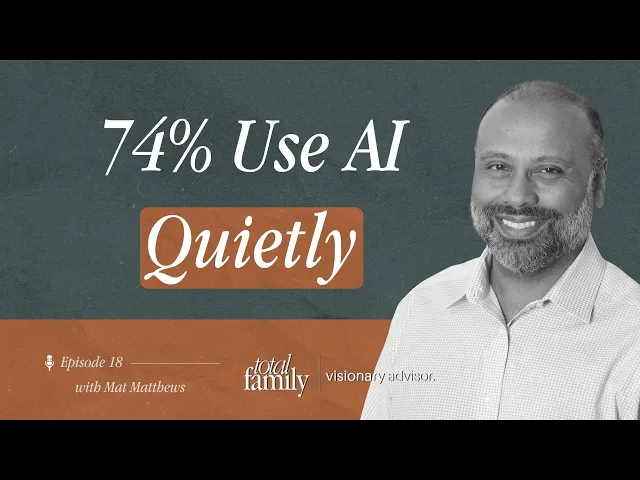
Three quarters of wealth advisors say artificial intelligence is already improving their practice. Only one in five is telling their clients about it.
That single contradiction is the story of where the wealth management industry stands right now. And according to Mat Matthews, Chief Product and Engineering Officer at Advisor360 and the architect of the 2026 Connected Wealth Report, it is not just a communication gap. It is a trust gap waiting to become a problem.
In Episode 018 of the Visionary Advisor podcast, Alex Kirby sits down with Mat to unpack the most surprising findings from this year's report, explore how advisors should be thinking about AI adoption, and make the case that the advisors who lead with transparency will be the ones who build the deepest client relationships in the years ahead.
The Contradiction at the Heart of the 2026 Report
The 2026 Connected Wealth Report, produced annually by Advisor360, tracks how wealth advisors are thinking about and using technology across their practices. This year, one finding stood above the rest.
"It wasn't actually a single number," Mat explains. "It was a contradiction between two numbers. 74% of advisors say AI is already helping their practice, up from around 64% two years ago. But at the same time, 21% are proactively talking about it with their clients. You've got this scenario where three quarters of the industry is benefiting from this new technology, but they're barely mentioning it to the people it's supposed to serve."
The top use cases remain firmly administrative: meeting summaries, CRM updates, meeting preparation, and client communications. For advisors still on the fence about whether AI belongs in a regulated, fiduciary-driven practice, those numbers offer some reassurance. Only 8% of advisors in the report said they would allow AI to rebalance a portfolio or execute trades without human review.
Fear Is Fading, But So Is Easy Optimism
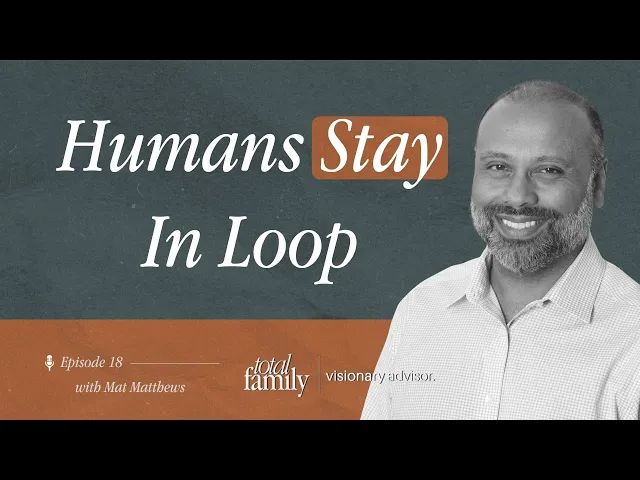
The sentiment shift from 2025 to 2026 tells a nuanced story. A year ago, 21% of advisors said AI was a threat to their livelihood. Today that number has dropped to 8%. That might seem counterintuitive as the tools become more capable, but Mat sees a clear reason for the shift.
"Advisors are getting a better sense of what really drives their worth and their value. It is those human interactions, trust, empathy. Their job is not just a bunch of administrative tasks or even investment management. It really is creating that connection with a person."
At the same time, optimism has tempered. The proportion of advisors who see AI as helpful to their practice has dipped from 85% to 74%. Mat's read on this is straightforward: the bar has been raised. Advisors are using AI in their personal lives and they are now expecting far more from the tools available to them at work.
Building Trust Like You Would With a New Hire
One of the most useful frames to emerge from the conversation is what Mat calls the "new assistant" analogy. Trust with AI is not switched on or off. It is earned incrementally, in the same way you would test a new team member before putting them in front of your most important client.
"You're not going to put them in front of your biggest client on day one," Mat says. "You're going to say: do some background tasks, help me with this, see how you get your legs working, and then graduate up. That's the evolution. We still see people saying: summarize my meeting notes, input data into my CRM, things that are reversible, that are not going to create long-term lasting damage, and then build up from there."
That progression matters for advisors who feel pressure to adopt AI faster than their confidence or their firm's policies allow. Trust in AI is not a decision. It is a process.
Silence Is Not Neutral: Why Hiding AI Use Harms Client Trust
Perhaps the most urgent argument in the episode is the one Mat makes about what happens when advisors simply say nothing about how they are using AI.
"When advisors avoid the topic, they're not creating neutrality. They're creating a vacuum. And the vacuum is going to get filled by the client. They're going to have their own assumptions."
With only 31% of consumers saying they are comfortable sharing all their financial data with AI, the majority of clients already carry concerns. If those concerns are never addressed by the person they trust most, their advisor, Mat argues they will simply fester.
The alternative is straightforward: flip the dynamic. Advisors who say "I am not hiding this, I am in control of this, and I am using this to give you better outcomes" are not just being transparent. They are demonstrating competence and reinforcing the very trust that defines their value.
As Alex puts it: "Firms have a real opportunity here. Frame it as innovation. Put it in your presentations. Tell your clients exactly which tools you are using and why. Get it on the table."
The Advisor's Expanding Role
Beyond the trust conversation, Mat and Alex explore where all of this is headed for advisors over the next two to three years. The data shows that 90% of advisors do not believe they will be obsolete within a decade, and Mat agrees with that instinct, though for specific reasons.
"We believe very firmly that advisors are really important because of trust, empathy, and judgment. Those are distinctly human characteristics." But the changes coming are still significant. Advisors will be able to service more clients than ever before, handle a wider range of capabilities across the full financial life of a family, and move from portfolio management toward what Mat calls the role of a "general contractor" for financial wellbeing.
The conversation at Total Family aligns directly with this shift. As Alex notes: "Just saying Matt manages our money maybe isn't as compelling as it used to be. But we're trying to get advisors to say: Matt understands our family's legacy. What our parents wanted. What I want for my children. That allows him to help us make decisions consistent with our values that aren't just simple financial decisions."
If the advisor's role is purely data aggregation or return calculation, AI can do that without any human in the loop. If the role is legacy partnership, built on cumulative knowledge, family context, and human judgment, that is a different conversation entirely.
The First Step for Any Advisor Who Is Still Skeptical
Not every advisor is an early adopter, and Mat's advice for those who remain cautious is as practical as it gets.
"Start with one thing. Just be open to one thing. Pick a repetitive task in your week that eats up your time, and just see. Let AI take a swing at it. Maybe that's meeting summaries, maybe it's CRM data entry. If you pay attention to what you do with the time you got back, that's a real signal. Can you spend it on deeper client prep? Can you run more scenarios? Can you make a phone call you've been putting off? Try something really small and see if that pays off for you."
That single shift, reclaiming time from administrative tasks and redirecting it toward client relationships, may be the most powerful argument for AI adoption available to any advisor today.
Listen to the Full Episode
The full conversation with Mat Matthews is available now on Apple Podcasts, Spotify, and YouTube. The 2026 Connected Wealth Report from Advisor360 is linked in the show notes.
If this episode challenged how you think about your role as an advisor and how transparency around AI can deepen rather than damage your client relationships, subscribe to the Visionary Advisor podcast and leave a review. It helps other forward-thinking advisors find the show.