Advisors

The AI wave is not the first time advisors have been told they are becoming obsolete. First it was the end of commissions. Then index funds. Then robo advisors. Then fee compression. Every decade brings a new reason the advisor is supposedly becoming irrelevant.
And every decade, the excellent ones prove that argument wrong.
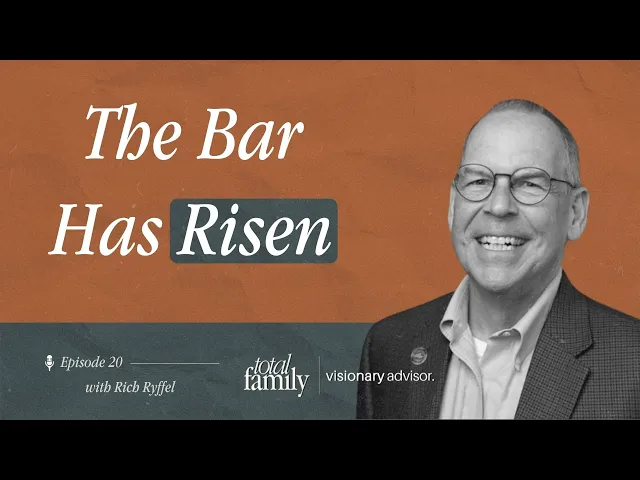
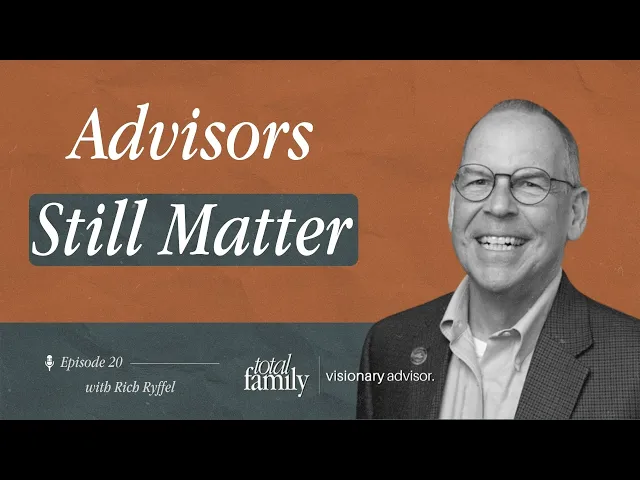
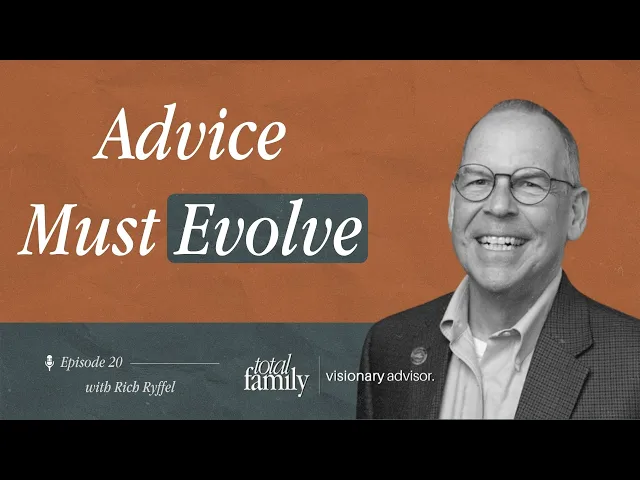
Rich Ryffel has lived all of it. With 35 years spanning A.G. Edwards, Edward Jones, JP Morgan Private Bank, and First Bank, and now as Executive Director of Business Leadership and Professor in Practice at Purdue's Mitch Daniels School of Business, Rich has the kind of perspective that only comes from living through multiple cycles of disruption.
In Episode 20 of the Visionary Advisor podcast, he sits down with Alex Kirby to talk about what has stayed constant through all of it, what is genuinely different this time, and what it actually means to be an excellent advisor in 2026.
The One Thing That Has Never Changed
Alex asked Rich what separates the advisors who have survived every cycle of disruption from those who did not, and the answer is immediate: quality of relationship.
"The excellent advisors have great relationships. Always have, always will have," he says. "The difference is now that because of the ubiquity of information and the ease of access, the quality of the relationship is more dependent on outcomes that are dependent on advice and expertise."
Thirty years ago, excellent advisors gave clients access to products and information they could not get anywhere else. That edge is gone. Today, a client can learn about 529 plans on Investopedia, run a portfolio model on a robo platform, and ask an AI agent to explain complex tax law in plain language. What they cannot get from any of those sources is judgment applied to their specific life or a human being who knows their family and what they are actually trying to build.
The bar has risen. The foundation has not moved.
Is AI Really Different This Time?
Rich gives an economist's answer: ‘on the one hand, and on the other hand.’
The parallel to the dot-com era is real. When the internet arrived, firms like A.G. Edwards and Edward Jones made a deliberate choice not to let clients trade online. They doubled down on the human relationship. Thirty years later, those firms are multiples larger than they were then, and the dozens of online trading startups from that era have largely been absorbed or shuttered.
"No technology really disintermediates everybody," Rich says. "We've got to keep the human in the loop."
What is genuinely different about AI is its reach. The internet changed how people accessed information. AI has the potential to change how people think through decisions, across healthcare, law, finance, and almost every other domain where expertise used to be scarce. That is a bigger surface area of disruption. But the firms that understand what is actually at risk and what is not, and that use AI to leverage their advisors rather than replace them, will be positioned exactly as Edwards and Jones were in 1995.
The Silver Lining: Complexity Is on the Rise
One of the most encouraging arguments Rich makes is aimed squarely at the students who ask him the same question every semester.
"Should I really be studying to be a wealth manager? Maybe I'll be out of business in twenty years."
His answer is no. And the reason is structural.
As the market bifurcates between complex clients who need human advisors and simpler situations that AI can handle well, the silver lining is that complexity is not shrinking. It is growing. Wealth is on the increase. The great wealth transfer from the baby boomers to their children is well underway. And every time wealth transfers, it creates an opportunity for an advisor to provide advice that genuinely changes outcomes.
"I'm bullish on the wealth management business," Rich says. "I'm bullish on it for students just now going in."
If there is a challenge in this episode, it comes in one of Rich's most direct observations. A lot of advisors, he argues, do not fully know what problem they solve.
"Thirty years ago, one of the problems excellent advisors solved was access to product. No longer an issue. One of the problems was education about investment alternatives. No longer an issue. One of the problems was portfolio construction. Robos kind of solved that. So what problem are we solving?"
This is the question every advisor needs to answer before walking into a room. Rich uses Alex's example of Taylor Swift to land the point: "Before you have that meeting, you've got to think what problem does somebody like her have that I can uniquely solve."
Starting with social security or a standard financial plan is not the answer. The advisors who will thrive are the ones who arrive already knowing what is keeping their client up at night and prepared to address it specifically.
The move toward planning credentials like the CFP is a step in the right direction, because planning is problem-focused rather than product-focused. But the shift in mindset has to go deeper than a credential. It has to become the default way an advisor prepares for every conversation.
How AI Turns New Advisors Into Experienced Ones
Rich spent years running teams at JP Morgan Private Bank and observed firsthand what separates advisors who get traction quickly from those who struggle through the early years. Almost always, it came down to preparation. The experienced advisors had seen it all. They walked into a meeting with a school teacher and already knew what a school teacher's financial life typically looked like, what questions to ask and what solutions were most likely to be relevant.
New advisors did not have that. Until now.
He references his case study on Edward Jones and their use of AI to illustrate the shift. With twenty thousand advisors making a million calls a year, many of those advisors are new and calling on clients they have never worked with before. AI changes their preparation completely.
"You can say: I'm going to call on a school teacher who is forty, makes this salary, has a retirement plan and TIAA-CREF, and is married to someone who does this. Now I can go in completely prepared. Absent that tool, I would have done the classic show up and throw up kind of thing, just spewing features and hoping something lands. But now I can come in with: do you have this problem? I can solve it. Here is how."
The reduction in new advisor failure rates alone, Rich argues, is a compelling case for AI adoption. What allowed advisors to be excellent was experience. Now you can compress years of experience into preparation for a single call.
Unreasonable Hospitality and the Shake Shack Lesson
One of the most unexpected and rewarding sections of the episode is a conversation about Danny Meyer, the restaurateur behind Union Square Hospitality Group and Shake Shack, and what his philosophy of unreasonable hospitality teaches wealth management.
When Shake Shack introduced kiosk ordering, many people saw it as the opposite of the high-touch service Meyer had built his reputation on. Rich sees it differently, and the analogy to financial services is direct.
"What they said was: we're going to reallocate the humans to even higher touch, higher value activities. Rather than have someone stand at a register taking orders, that person can now walk through the restaurant and say, is everything okay? Is there anything I can get for you? I see your kids are restless, can we get them a free ice cream cone?"
The technology handled the transactional. The humans were freed to do what only humans can do.
This is exactly the model advisors should be building. Let AI handle meeting summaries, CRM updates, portfolio reporting, and call preparation. Use the time that creates to walk through the restaurant, to listen between the lines of what a client is actually telling you, and to act on what you hear before they even ask.
Rich recalls setting up college tours and connecting clients with professors at universities his own children attended, simply because he had listened carefully enough in a planning conversation to know that college selection was on a client's mind. That was not in a cash flow analysis. It was in the margins of the relationship. And that is where loyalty is built.
Until You Have an Order, You Are the Product
Rich shares one of the most memorable lines of the episode, passed on by a guest lecturer in one of his classes: "Until you have an order, you are the product."
When a prospective client is evaluating an advisor, they are not only assessing investment philosophy or fee structure. They are running a preview of what it will feel like to work with that person. Is this advisor responsive? Do they follow up when they say they will? Do they show up prepared? Do they make me feel like I matter?
"The marketing or selling process is a trial run of how you will behave when you are a vendor to the client. That courtship is indicative of the marriage."
Alex shares a version of this from his own experience hiring an intern. One candidate showed up with five custom slides about the company, asked thoughtful questions, and sent a thank-you note afterward. She was the only person out of all the candidates who followed up. She got the job. Not because of what she said in the interview, but because of the behavioral signals she sent before a single decision had been made.
SUSUFU: The Simplest Competitive Edge in the Business
Rich closes with an acronym that sounds deceptively simple and is, in his experience, more rare than it should be: SUSUFU. Set up, show up, follow up.
"Forty years of working, most people, including people in business, including people that are relatively successful, do not follow up and do not act with urgency. If you just do those two things, you are ahead of so many people."
Setting up means knowing your client, knowing what you are going to say, and knowing what you are not going to say before you walk in. Showing up means being present, prepared, and on time. Following up means closing the loop quickly and making the other person feel like they matter.
None of this is complicated. All of it is uncommon. A manager Rich worked with at Bank of America used to say that ninety percent of leadership is showing up. The same is true in client relationships. The advisor who does the unremarkable things remarkably consistently will outlast almost every wave of disruption, because those behaviors signal exactly the qualities clients are trying to buy: reliability, care, and the sense that they are not one of many, but the only one that matters.
Listen to the Full Episode
The full conversation with Rich Ryffel is available now on Apple Podcasts, Spotify, and YouTube.
If this episode gave you a clearer sense of what it means to be an excellent advisor in 2026 and what has stayed the same across 35 years of change, subscribe to the Visionary Advisor podcast and leave a review. It helps other forward-thinking advisors find the show.
[SUBSCRIBE ON APPLE PODCASTS] [SUBSCRIBE ON SPOTIFY] [WATCH ON YOUTUBE]