Advisors

Families do not experience wealth as a balance sheet.
They experience it through relationships, capabilities, identity, and opportunity across generations. Over time, it becomes clear that financial capital alone does not determine whether a family thrives.
As Jay Hughes has said, a family is a social system, not an economic system. The true wealth of a family is its well-being.
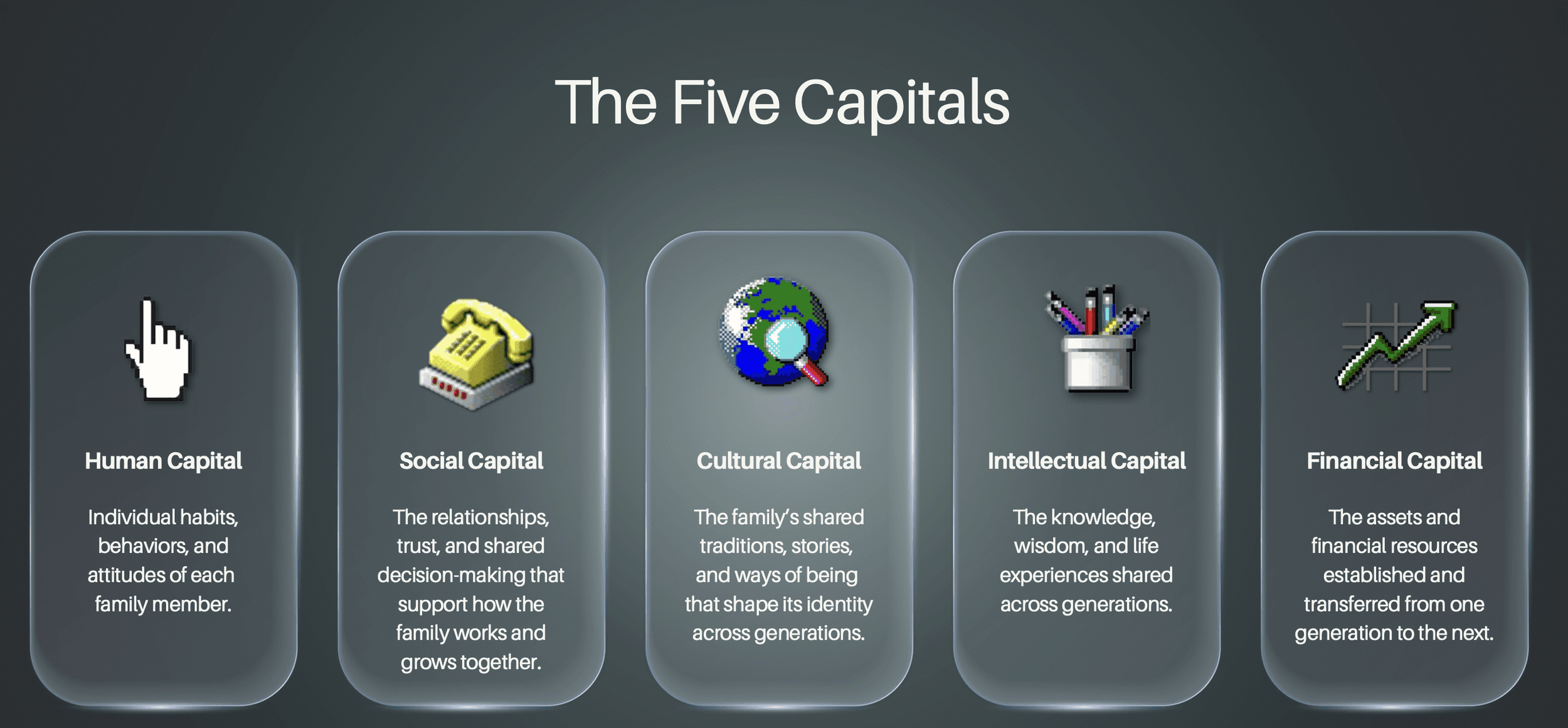
This perspective has shaped how many leading advisors and family offices now think about family wealth, often through the lens of the Five Forms of Family Capital:
Financial capital
Human capital
Social capital
Intellectual capital
Cultural capital
Each form contributes to long-term family well-being. When one is overlooked, the system becomes fragile.
In legacy planning conversations, this broader definition of wealth changes everything.
What Advisors See in Practice
One advisor shared something we hear often.
When conversations focus only on financial capital, engagement tends to be narrow. The discussion centers on performance, structure, and technical planning.
When conversations expand to include family history, shared values, life lessons, and long-term vision, more family members lean in.
Spouses participate differently.
Children and inheritors become more curious.
Conversations feel relevant beyond the numbers.
Talking about more than financial capital changes who shows up — and how they engage.
That shift matters in any meaningful intergenerational wealth transfer.
Why This Matters for Advisors
Advisors sit at the intersection of money and meaning.
They are often the only professionals who see how financial decisions intersect with education, health, relationships, and long-term opportunity. Over time, advisors develop a deep understanding of how families actually function — not just how portfolios perform.
Engaging across the Five Forms of Family Capital does not require advisors to step outside their role. It gives them better context for the work they are already doing.
When advisors adopt this broader lens of family wealth:
Conversations become more inclusive
Relationships extend across generations
Advisors gain relevance with future decision-makers
This depth supports continuity in a way performance alone cannot.
It also strengthens retention when assets move, because the advisor is connected to the family’s identity — not just the balance sheet.
Financial Capital as an Enabler
Financial capital works best when it supports the other forms of capital.
It enables education and skill development.
It supports resilience and adaptability.
It strengthens networks and opportunity.
It preserves family values and identity.
When financial capital becomes disconnected from these outcomes, families can struggle despite significant resources.
This is where legacy work becomes practical. Advisors who understand the Five Forms of Family Capital are better equipped to guide families through complexity — not just planning decisions.
Financial capital is powerful.
But it functions best when it serves something larger.
A Broader View of Wealth
The future of wealth management is not about abandoning financial rigor.
It is about integrating financial expertise into a more complete understanding of family well-being and long-term continuity.
Advisors who engage beyond financial capital help families build:
Capability
Shared understanding
Stronger relationships
Clearer identity across generations
That is what modern legacy work looks like in practice.
And that is what wealth advice increasingly requires.